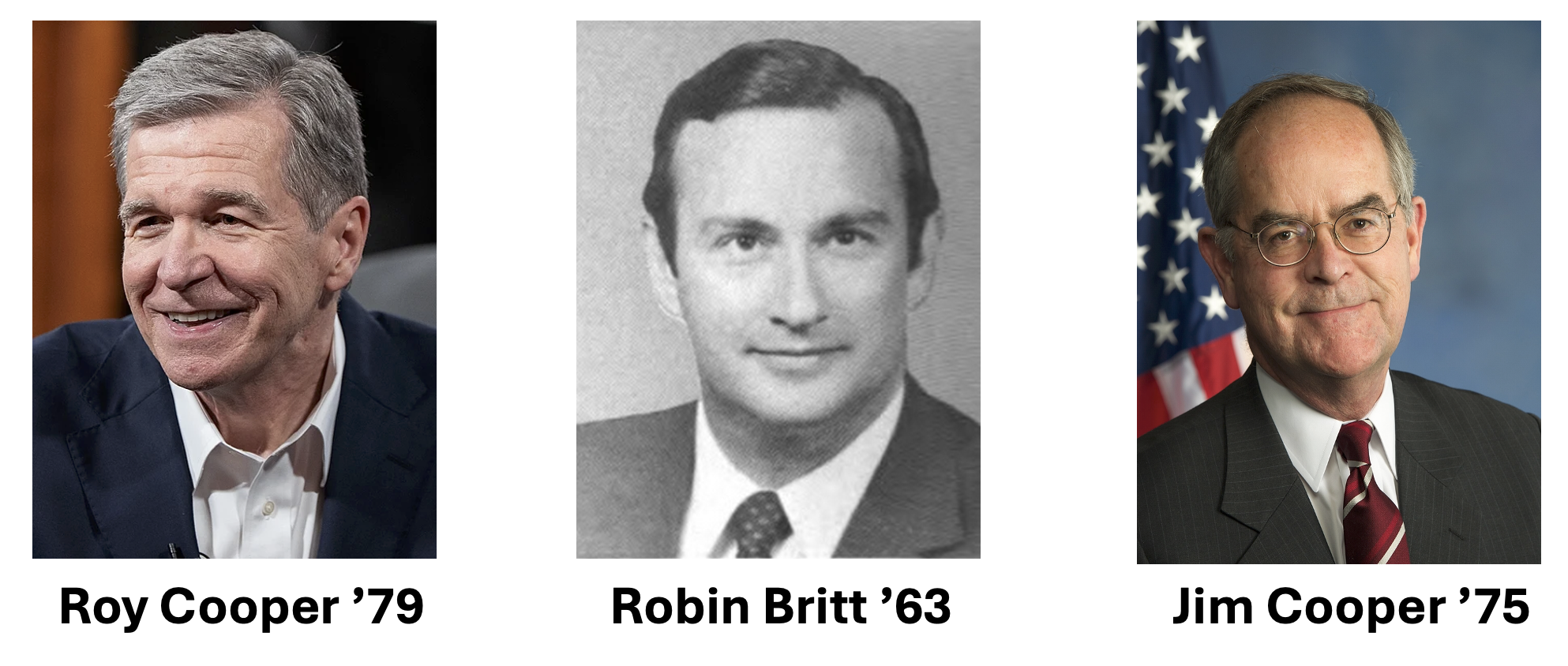
On Tuesday, November 3, Roy Cooper defeated Michael Whatley in the U.S. Senate election in North Carolina. He will begin his six-year term in 2027. Roy Cooper joins Sigma alumni Robin Britt and Jim Cooper (no relation) in serving in U.S. federal government.
Roy Cooper – From Nash County to Raleigh to Washington, DC
Roy Cooper ’79 has built a distinguished career in law and public service, serving North Carolina in the General Assembly, as Attorney General, and as the state’s 75th Governor. Most recently, he was elected to the United States Senate.
A native of Nashville, North Carolina, Roy Cooper attended the University of North Carolina on a Morehead Scholarship, graduating in 1979 with a degree in political science. At Carolina, he was also involved in campus leadership as president of UNC’s Young Democrats. He subsequently earned his law degree from UNC in 1982 and returned to eastern North Carolina to practice law in Rocky Mount, where he spent 18 years representing individuals and businesses.
Roy Cooper entered public service in 1987 when he was elected to the North Carolina House of Representatives. He moved to the State Senate in 1991 and served as Senate Majority Leader from 1997 to 2000. During his legislative career, he championed public education, teacher compensation, children’s health insurance, and consumer protection. Among his legislative accomplishments was helping enact North Carolina’s 1999 Predatory Lending Law, one of the first measures of its kind in the nation.
In 2000, Roy Cooper was elected North Carolina Attorney General, a position he held for four consecutive terms from 2001 to 2017. His nearly 16 years in office represent the longest tenure of any attorney general in state history. In that role, he focused on public safety, consumer protection, fighting predatory lending, protecting children, and addressing drug-related crime.
In 2016, Roy Cooper was elected Governor of North Carolina, defeating incumbent Pat McCrory, and was reelected in 2020. During his two terms (2017–2025), he emphasized economic development, public education, health care access, workforce development, and disaster recovery. Among the significant initiatives of his administration were expanding Medicaid, increasing teacher salaries, addressing the opioid crisis, and securing investments in jobs and economic development. Medicaid expansion ultimately extended health coverage to more than 650,000 North Carolinians.
Following eight years as governor, Roy Cooper continued his career in public service by running for the U.S. Senate. On November 3, 2026, he defeated Republican Michael Whatley, winning the seat being vacated by Senator Thom Tillis. His election makes him North Carolina’s next U.S. senator.
Throughout his career, Roy Cooper has combined his legal background with more than three decades of elected public service. His progression from a Chi Psi undergraduate at UNC to state legislator, attorney general, two-term governor, and now U.S. Senator-elect represents a notable record of leadership and public service in North Carolina.
Roy Asberry Cooper, III, a Morehead Scholar, was a political science major and was a member of the Golden Fleece, Order of the Grail, and the N.C. Academy of Trial Lawyers (during law school).
Robin Britt – A Career in Law, Public Service, and Government
Robin Britt ’63 has devoted much of his professional life to public service, combining careers in law, military service, and government. A native of San Antonio, Texas, Britt grew up in Asheville, North Carolina, and graduated from UNC in 1963. He subsequently earned his Juris Doctor from UNC in 1973 and a Master of Laws degree from New York University in 1976.
Following his admission to the North Carolina Bar in 1973, Britt established his legal practice in Greensboro. Alongside his legal career, he served in the United States Naval Reserve from 1963 to 1984, attaining the rank of Commander. His commitment to public service also led him into political leadership, including serving as chairman of the Guilford County Democratic Party from 1979 to 1981.
In 1982, Britt was elected to the United States House of Representatives, representing North Carolina’s Sixth Congressional District. He served in the 98th Congress from January 1983 through January 1985, representing the Greensboro area at the national level. He subsequently remained active in public affairs and continued his involvement in North Carolina politics.
Britt’s career in public service continued beyond Congress. He served as president and director of Project Uplift in Greensboro before being appointed Secretary of the North Carolina Department of Human Resources by Governor Jim Hunt. From 1993 to 1997, he led this important state agency, overseeing responsibilities involving human services and public welfare. He later served on Governor Hunt’s staff from 1997 to 1998.
Across his career, Britt demonstrated a sustained commitment to serving his community, state, and country. His professional journey—from practicing law and serving in the Naval Reserve to representing North Carolina in Congress and leading a major state department—reflects a life shaped by leadership, civic engagement, and public responsibility.
Charles Robin Britt, Sr., was an English major and was a member of the Honors Program, Naval ROTC, Society of Janus, student government, and the Wesley Foundation.
Jim Cooper – A Career in Public Service, Business, and Education
Jim Cooper ’75 has built a distinguished career spanning public service, law, business, and higher education. His career reflects an enduring commitment to public policy, bipartisan cooperation, and civic leadership.
A Morehead Scholar, Jim Cooper graduated from UNC in 1975 with highest honors, earning degrees in history and economics. He was also co-editor of The Daily Tar Heel. He subsequently received a Rhodes Scholarship to study at Oxford University, where he earned a degree in philosophy, politics, and economics in 1977, before completing his law degree at Harvard Law School in 1980.
After beginning his career as an attorney in Nashville, Tennessee, Jim Cooper entered public service at a remarkably young age. In 1982, at age 28, he was elected to the U.S. House of Representatives, representing Tennessee’s 4th Congressional District from 1983 to 1995. During this first period in Congress, he served on the House Energy and Commerce and Budget Committees, focusing particularly on health care, telecommunications, environmental policy, consumer protection, and issues affecting rural communities.
Jim Cooper then left Congress and pursued a career in business, serving as managing director at Equitable Securities and co-founding Brentwood Capital Advisors, a Nashville-based investment banking firm. He also maintained a longstanding commitment to higher education, teaching for approximately 20 years at Vanderbilt University’s Owen Graduate School of Management.
In 2002, Jim Cooper returned to Congress, representing Tennessee’s 5th Congressional District, centered in Nashville, from 2003 through January 2023. During his second tenure, he became known for his independent-minded approach and willingness to work across party lines. He was a prominent member of the bipartisan Blue Dog Coalition and served on several influential committees, including Armed Services, Budget, Oversight and Reform, and the House Permanent Select Committee on Intelligence. He eventually chaired the Armed Services Subcommittee on Strategic Forces, overseeing issues involving nuclear weapons, missile defense, and national security space programs. He also authored the No Budget, No Pay Act, which became law in modified form in 2015. Jim Cooper’s extensive committee service and approach to bipartisan problem-solving earned him a reputation as an influential voice for fiscal responsibility and civility in Congress.
Following his departure from Congress in 2023, Jim Cooper continued his involvement in business, public policy, and education. He became a principal at TVV Capital, a private equity firm specializing in U.S. manufacturing, and a Distinguished Scholar at Vanderbilt Law School, where he teaches about Congress and the legislative process. He is also a WISC Global Fellow at New York University’s John Brademas Center, contributing to discussions of national security and international policy. His continuing interests include the history of national security space and the strategic importance of satellite technology.
Jim Cooper’s career represents an exceptional combination of academic achievement, public service, business leadership, and intellectual engagement. From his beginnings at UNC and the Lodge to his studies as a Rhodes Scholar, his distinguished congressional career, and his continued contributions to business and higher education, he has demonstrated a sustained commitment to leadership and public affairs. His accomplishments make him a particularly notable alumnus of the Alpha Sigma of Chi Psi.
James H. S. Cooper, a Morehead Scholar, was a history and economics major. He was a member of the Golden Fleece, Honors Program, Order of the Grail, and Order of the Old Well, and also served as co-editor of The Daily Tar Heel. He was also awarded a Rhodes Scholarship.